Is SEO really dead? How SEO, GEO and AEO actually work together in AI search.
Topic
AI, SEO, GEO, and AEO4 min read
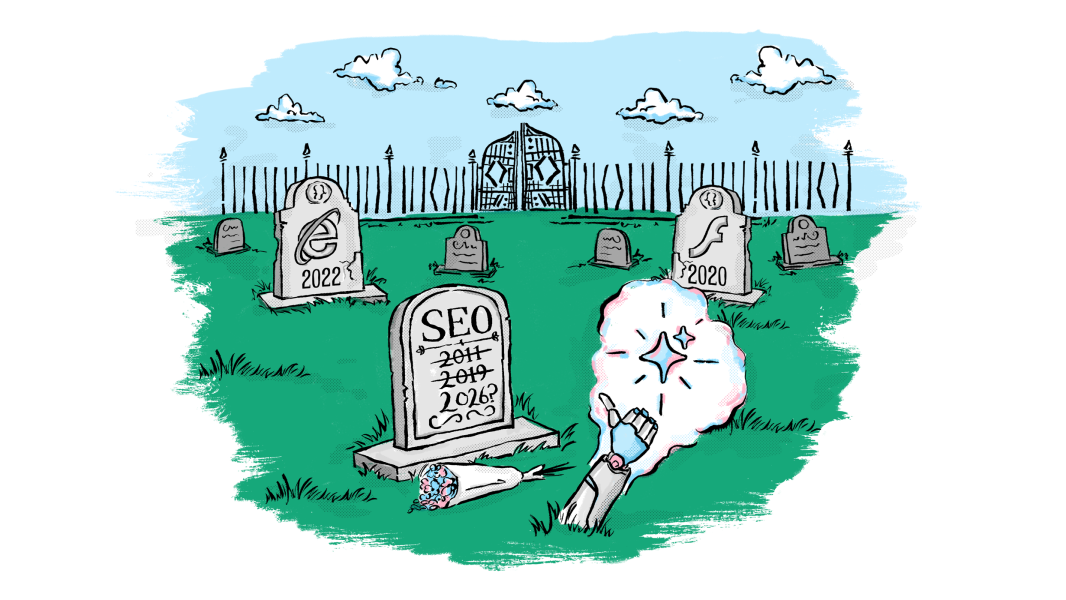
“SEO is dead.” It’s a claim that resurfaces every time there’s a major shift in search. Now, with AI engines delivering convenient, fast and simplified answers in seconds, the argument sounds louder than ever. But is SEO truly finished or are we confusing a platform shift with a fundamental collapse?
Search has changed dramatically since the adoption of AI. Instead of typing fragmented keywords and scanning a page of blue links, users are now asking full questions and receiving summarised responses from Large Language Learning (LLM) models like ChatGPT and Claude, Google’s AI Overviews, Microsoft Copilot and Perplexity.
Queries have become conversational. Answers are presented as structured, digestible insights. Visibility is no longer just about appearing on page one – it’s about being selected, summarised and cited.
But here’s what hasn’t changed – AI systems don’t create information out of thin air. They retrieve, interpret and combine content from the web. And the web is still structured, discovered and validated through SEO.
AI platforms aren’t replacing search engines. They’re repackaging them.
Traditional search engines retrieve and rank pages. AI engines retrieve, interpret and generate responses using those same indexed sources. The difference is presentation, not dependency.
When someone searches for “marketing agencies in Manchester,” they’re usually looking for options. They want to compare websites, scan credentials, review case studies and make their own decision. A traditional search engine is ideal for that.
But when someone asks “what should I look for when choosing a marketing agency?” or “do I need a specialist or full-service marketing agency?” they’re seeking interpretation and synthesis. That’s where AI platforms excel, summarising information, highlighting themes and delivering structured answers in seconds. Different intent. Different interface. Same underlying requirement: high-quality, crawlable, structured content.
LLMs don’t magically “know” your business. They infer it from patterns across the web. If your site isn’t technically sound, well-structured and clearly positioned, you are invisible – whether the interface is Google or ChatGPT.
What actually died (and what didn’t).
Let’s be clear: parts of SEO are obsolete. Keyword stuffing is dead. Thin content designed purely to rank is dead. Low-quality link schemes are dead. Writing for algorithms instead of humans is dead. SEO is no longer about manipulating search engines. It’s about structuring information so machines can understand it and humans can trust it.
SEO has evolved into what many now call “Search Everywhere Optimisation.” That includes visual search, voice search, social discovery and AI-driven summaries. Generative Engine Optimisation (GEO) and Answer Engine Optimisation (AEO) aren’t separate disciplines. They are natural extensions of modern SEO, adapted for citation and synthesis within AI-driven environments. The tactics changed. The foundation didn’t.
Technical SEO: the Infrastructure AI depends on.
Here’s the uncomfortable truth behind the “SEO is dead” narrative: most businesses never did technical SEO properly in the first place.
Crawlability still matters. If search engines struggle to index your content, AI systems won’t retrieve it reliably either. Clean site architecture, logical internal linking and clear indexing signals are not glamorous, but they are non-negotiable.
Information architecture matters even more in an AI-driven landscape. LLMs interpret relationships between entities. If your services, industries, case studies and thought leadership content aren’t structurally connected, you weaken your authority signals. A well-organised site doesn’t just help users navigate, it helps machines understand how topics relate.
Performance still matters. Slow, bloated sites signal poor quality. Technical health influences crawl efficiency, user engagement and overall domain trust, all of which impact whether your content is surfaced or ignored.
Structured data is no longer optional. Schema markup clarifies who you are, what you offer and how content should be interpreted. AI systems rely heavily on entity clarity. If your organisation, services and expertise are inconsistently defined, LLMs struggle to confidently include you in generated responses.
And then there’s authority. Backlinks, industry accreditations, author credibility and consistent brand positioning all contribute to trust. LLMs are probability machines. They surface sources that appear credible across the broader web ecosystem.
Strip away technical SEO and you don’t just lose rankings, you lose eligibility for AI citations and inclusion.
How SEO stacks with GEO and AEO.
Think of it as layers. SEO makes your content accessible and trustworthy. GEO strengthens topical authority so your brand becomes citation-worthy. AEO ensures your content is structured clearly enough to be extracted as a direct answer.
Without technical SEO, GEO has nothing stable to sit on. Without authority and structure, AEO has nothing reliable to extract. This isn’t a replacement model. It’s a stacking model. Businesses chasing AI visibility without strengthening technical SEO are essentially building on sand.
The commercial reality.
The companies winning in AI search right now aren’t abandoning SEO. They are doubling down on technical foundations and layering AI-focused optimisation on top.
They are cleaning up architecture. Strengthening entity clarity. Improving site speed. Implementing structured data properly. Then they’re refining content to make it more extractable, authoritative and aligned with conversational search behaviour.
That’s not hype. That’s infrastructure. And infrastructure is rarely visible until it fails.
So, what comes next?
Technical SEO gets you indexed and trusted. GEO and AEO increase your chances of being cited and surfaced in AI-generated answers. SEO isn’t dead. It’s just grown up.
At Holdens, we help brands strengthen their technical SEO, clarify their positioning and structure their content so it performs, not just in traditional search results, but inside AI-generated answers as well. From crawlability and site architecture to entity clarity and citation strategy, we make sure your website isn’t just visible, but usable by the platforms shaping modern search.
If you want to be found, trusted and selected, not just ranked, let’s talk.
Other blogs
Category
InsightTopic
Experiential activations
10 mins read

Category
Agency NewsTopic
Agency News
2 mins read