Brand Campaigns Aren’t a Costly Luxury – They’re Your Performance Marketing’s Best Friend
Topic
Digital Marketing10 mins read
Every marketer knows the feeling. You launch a paid social campaign on a Monday and by Friday you have a dashboard full of clicks, conversions and a CPA that makes the CFO smile. Compare that to brand campaigns, where the honest answer to “what did that campaign achieve?” is often “ask us again in eighteen months.” Given that choice, it’s no surprise where ever-decreasing budgets tend to flow.
Performance marketing is seductive because its feedback loop is short. A platform dashboard reports clicks and conversions within hours, in a way that feels indisputable even when the attribution underneath it is shakier than it looks. Brand campaigns can be measured just as rigorously – more on that shortly – but its results surface over quarters, not days, which makes it a harder sell in a culture built around weekly reporting. That difference in speed, not a genuine difference in measurability, is what pushes incremental budget toward performance channels and often makes brand building the first line item cut when things get tight.
What performance marketing can and can't prove.
The trouble is that performance marketing, run on standard last-click reporting, tends to overstate itself by mostly harvesting demand that already exists. Search ads catch people with intent who already know what they want. Retargeting reminds people who already considered you. Platform dashboards take credit for the sale regardless of what actually caused it. Rigorous incrementality testing, such as geo holdouts, matched-market experiments, PSA or ghost-ad tests, is exactly the discipline that closes this gap, separating demand a campaign genuinely created from demand it simply intercepted and every performance-led team should be running it. But even a perfectly incrementality-tested campaign can only prove it converted people who were already close to a decision – it has very little power to grow how many people are close to a decision in the first place. That’s the resource brand building exists to grow and it’s the one nobody’s weekly dashboard is watching.
That resource is mental and physical availability: how easily people think of your brand when a need arises and how easily they can find and buy it when they do. This is where brand building earns its keep and where the case against short-termism gets concrete rather than sentimental. The Ehrenberg-Bass Institute for Marketing Science tracked what happens when brands stop advertising altogether. Sales fell by an average of 16% in the first year without any brand advertising, 25% by year two and 36% by year three. Among brands that paused for a full year, most never returned to their previous growth trajectory even after resuming spend. Smaller and challenger brands fared worse than larger ones, which have enough stored-up mental availability to coast for a while before the cracks show. That lag is exactly what makes the trade-off so easy to miss internally: the damage doesn’t show up on this quarter’s dashboard, so it doesn’t feel like a decision at all.
How brand actually changes behaviour.
It helps to understand why mental availability works the way it does, because it explains why performance marketing can’t build it on its own. Most purchase decisions aren’t reasoned through – they’re made fast, on autopilot, using mental shortcuts – what behavioural science calls System 1 thinking. Brand building’s real job is to plant and refresh the memory structures that get retrieved in that split second: associations between your brand and the moments when people need something in your category (“category entry points,” in Byron Sharp’s terms), plus the distinctive assets – a colour, a logo shape, a sonic cue, a tone of voice – that let people recognise and recall you without having to think.
This is also how brand building drives genuine behaviour change rather than just reinforcing existing preference. Repetition of the right cues, in the right context, over time, is what nudges a brand from “unconsidered” to “the obvious choice” for a whole new set of buyers – not by winning an argument, but by becoming the easy, familiar answer before an argument is even needed. Performance marketing operates almost entirely in the moment those shortcuts are already triggered – it has very little role in building them in the first place. A retargeting ad can’t create a memory structure that doesn’t exist yet and a search ad only works if your brand is already one of the few options that comes to mind. That’s precisely the inventory brand building exists to build up.
Performance marketing harvests - brand building plants.
This is also why the “brand vs. performance” framing is a bit of a false fight. Les Binet and Peter Field’s research, popularised as the 60/40 rule, found that the businesses generating the strongest long-term growth and profit typically weighted spend around 60% toward brand building and 40% toward sales activation. Not because performance doesn’t matter, but because brand building is what makes performance marketing cheaper and more effective. A brand that’s front of mind and easy to recognise gets clicked on more, converts at a higher rate and commands a price premium that outlasts any single campaign. Every performance channel a business runs – paid search, paid social, retargeting – inherits the quality of the brand behind it. Strong brand equity lowers cost per click, lifts conversion rates and reduces the discounting needed to close a sale, which is a fairly direct route from “brand” to “performance,” even if it doesn’t show up neatly attributed in a single dashboard.
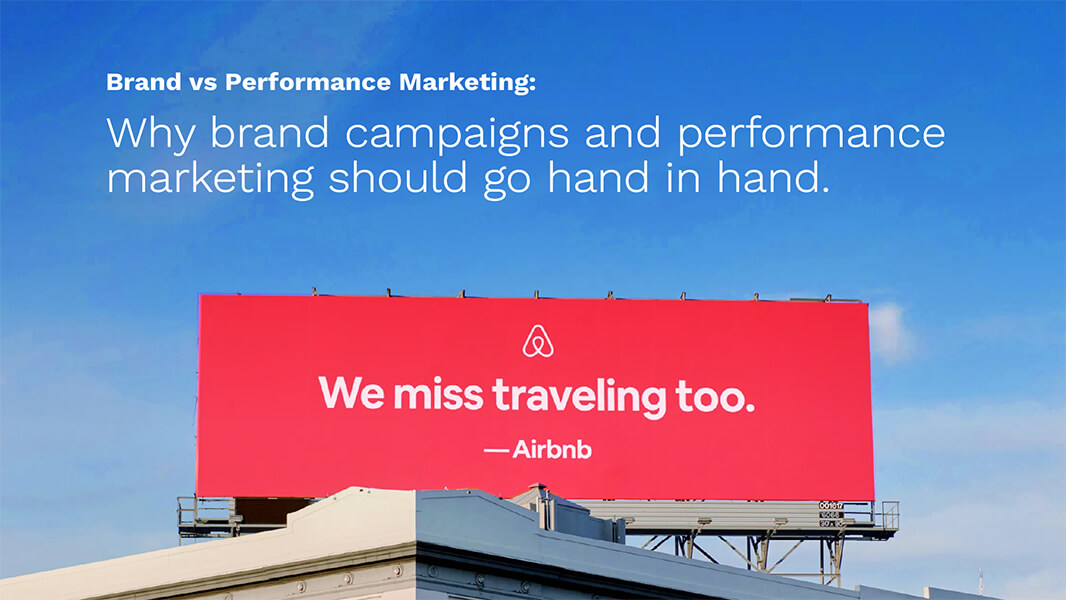
Airbnb is a useful real-world case. Around 2019, the company deliberately pulled back on performance channels, particularly bidding on its own brand name in paid search, and redirected spend toward brand campaigns such as “Made Possible by Hosts,” leaning on distinctive creative and PR instead. Demand didn’t dry up. By 2021, Airbnb reported traffic in its campaign markets running roughly 20% ahead of pre-pandemic levels, with the large majority of bookings arriving through direct or unpaid channels rather than paid acquisition, even as sales and marketing costs fell sharply. It’s worth being honest that as the business has scaled since, Airbnb has reinvested in paid and performance channels too – brand building isn’t a switch you flip once and never revisit. But the pivot demonstrated the mechanism this piece is describing in the wild: a stronger, more distinctive brand meant Airbnb had to buy back far less of its own demand.
None of this is an argument against performance marketing, which remains one of the most efficient ways to convert real, present demand, especially when it’s held to a genuine incrementality standard rather than platform-reported vanity metrics. It’s an argument against treating it as a self-sufficient growth engine. A business that pours everything into harvesting today’s demand while starving the activity that creates tomorrow’s demand is, in effect, financing this quarter’s results with next year’s growth. The bill doesn’t arrive immediately, which is precisely what makes it easy to defer.
Brand building is measurable - it just runs on a longer clock.
The bigger mistake in that trade-off is assuming brand building can’t be held to the same standard. It can. It just needs different instruments, run consistently over time rather than checked once a week:
- Brand tracking studies. Regular surveys of spontaneous and prompted awareness, consideration and purchase intent, benchmarked against competitors – the brand equivalent of a conversion funnel.
- Share of search. Les Binet’s metric compares your brand’s share of category search volume via Google Trends against competitors’. Research backing it has found it tracks closely with market share and tends to move ahead of it, making it a free, monthly leading indicator.
- Media mix modelling (MMM) or econometrics. Statistical models that isolate brand advertising’s contribution to sales from performance channels, price, seasonality and competitor activity – the standard method large advertisers use to put a number on long-term brand ROI.
- Distinctive asset recognition testing. Research checking whether people can identify your brand from a colour, shape or sound alone with the name and logo hidden – a direct read on whether your memory structures are actually forming.
- Incrementality tests on brand campaigns themselves. Running brand advertising in some regions and holding it out in others, then comparing search volume, direct traffic and sales lift between the two.
Run consistently, these give brand building the same kind of evidence trail performance marketing has always had. It’s just measured in months and quarters rather than clicks, because that’s the timeframe the behaviour it’s changing actually happens on.
The businesses that compound well over time tend to hold both truths at once: performance marketing tested for real incrementality rather than reported conversions and brand investment tracked with the same rigour – awareness, share of search, distinctive asset recall – over the longer horizon it actually operates on. The question worth asking isn’t whether to invest in brand or performance, or which one is easier to measure. It’s whether this year’s marketing plan is building the demand and the evidence trail that next year’s performance marketing will need something to convert.
Where does your marketing mix stand today?
Most marketing plans we review lean further toward performance than the evidence says they should. Not through bad judgement, but because brand’s payoff is slower to show and harder to defend in a monthly report. If you’re not sure whether your current split is genuinely earning its long-term keep, or you want a clear read on how to start measuring brand with the same rigour as your performance channels, get in touch with us and we’ll help you find the right balance for your business.
Other blogs

Category
AdvertisingTopic
Campaigns of the Month
10 mins read
Audio version available

Category
Agency NewsExperientialTopic
Agency News
2 mins read